Breaking the Walls: Designing Your Organization for Total Connectivity

Focus for March 2026
Strengthening the Root: Identifying the core principles and systems that support your business and personal growth before pursuing further expansion.
Why Your Organization is Failing at Scale: The Hidden Power of Anti-Silo Architecture
Please like the video and subscribe to the channel for more videos.
In the theater of modern enterprise, the most significant barriers to growth are rarely external competitors. Instead, they are the internal, invisible walls that trap information within isolated rooms. These barriers, known as silos, are not merely departmental boundaries; they represent a systemic failure of design that breeds entropy. When an organization organizes by role without prioritizing connectivity, it inadvertently creates a fragmented collective, one where teams lack the shared knowledge and data liquidity required to thrive.
To achieve true scale, leadership must view "The System" through the lens of Anti-Silo Architecture. This is an architectural manifesto that positions connectivity as the default state rather than a secondary consideration. By "strengthening the root", reimagining the foundational protocols through which data and people interact, an organization transcends its fractured state to become a unified entity capable of moving with singular purpose.
The Compounding Liability of Shadow Work
Isolation is not a neutral state; it carries a heavy "invisible tax" that erodes an organization’s bottom line. The most prominent manifestation of this tax is "shadow work",the staggering amount of time employees waste navigating the seams between departments. When a system lacks architectural integrity, workers spend more energy trying to find information than they do performing their primary duties.
In critical sectors like community hospitals, these isolated data pockets have dire consequences: patients may undergo redundant medical testing simply because one facility cannot access the records of another. In a corporate context, this fragmentation manifests as analytical blind spots and delayed decision-making. These costs compound over time, stifling research and development and leaving the organization unable to respond to market shifts.
"When information is restricted, progress is stymied, and innovation remains out of reach."

The Linguistic Foundation: Why Shared Vocabulary is Non-Negotiable
The friction of shadow work is often a direct result of a linguistic failure. For information to move through a system without "translation errors," there must be a shared data language. Anti-Silo Architecture mandates information standards, ensuring that disparate software systems and teams utilize the same vocabulary.
This interoperability is a structural necessity. By implementing a standardized interface or a common data model, an organization ensures that data flows safely and seamlessly. When every department is in agreement on these standards, the friction that typically halts complex projects evaporates. This is the first step in ensuring the "root" of the organization (its data flow) is robust enough to support rapid expansion.
Eliminating Fragmentation through a Single Source of Truth
Even with a shared language, a system remains vulnerable if its data is distributed across conflicting reports, the "ten spreadsheets" problem. Anti-Silo Architecture resolves this by establishing a Single Source of Truth (SSOT). This is a coherent, accessible framework that consolidates disparate data into a centralized architecture.
Adopting a "control tower" approach allows for a unified view of all organizational metrics. This consolidation prevents teams from wasting countless hours reconciling conflicting data sets. When the architectural integrity of the data is guaranteed, teams can stop auditing the past and start creating value for the future.
Strategic Fluidity via Open Access Points
A central truth is only powerful if it is accessible. Architectural connectivity requires that tools and systems possess the innate ability to communicate. This is achieved through open access points, primarily API-based integrations, which facilitate a "loosely coupled" environment.
Designing systems that plug into one another with ease is a strategic hedge against obsolescence. It allows an organization to introduce new technologies or workflows without a total infrastructure overhaul. These open access points ensure that the system remains resilient, adaptable, and ready to integrate the next wave of digital transformation without breaking the existing foundation.
Speed and Systemic Resilience as the Ultimate Competitive Edge
When an organization successfully moves toward total connectivity, the transformation is profound. By strengthening the root, the enterprise gains a set of competitive advantages that are impossible to replicate in a siloed environment:
Unmatched Speed: Decision cycles are compressed. By streamlining access, the time required to retrieve critical information can be reduced from days to seconds.
A Culture of Innovation: Connectivity allows every employee to see the "big picture." By exposing diverse perspectives to the same data, the organization invites a higher level of collaborative innovation.
Systemic Resilience: Connected systems are inherently harder to break. By removing isolated points of failure, the organization gains the capacity to cope with complexity and adapt to sudden changes.
"Strengthening the root: creating a foundation that supports growth even in changing environments."
A Roadmap for Implementation: Auditing Your Walls
Transitioning to an Anti-Silo Architecture is an exercise in both technical precision and cultural leadership. It requires a systematic audit of where information currently remains stagnant. Leadership must identify the "black holes", those departments or software tools where data enters but never returns to the broader system.
Once these walls are identified, the organization must prioritize integration, selecting tools that offer real-time data access and automated workflows. However, technology is only half of the equation. Leadership must foster "cultural connectivity", a climate of trust and inclusion where people are encouraged to share. A shipping company can have the best logistics software in the world, but if the captains and the dockworkers do not trust the shared data, the system will fail.
Conclusion: Moving as One Toward a Unified Future
Anti-Silo Architecture is not a mere technical upgrade; it is a fundamental strategy for long-term survival. In an era of rapid digital evolution, maintaining isolated data pockets is a form of professional negligence. When people, processes, and technology are in total agreement and fully connected, the organization gains the agility to respond to any market shift with precision.
By designing for total connectivity and strengthening your organizational roots today, you ensure that your entire system can move as one. If you audited your organization today, which "invisible wall" would you tear down first to let your data breathe?
Sources of Information
The information used to create the blog post "The Anti-Silo Architecture: Designing Your Organization for Total Connectivity" was derived from the following sources:
Document Name: Breaking Down Silos in the Workplace: A Framework to Foster Collaboration - PMC
Description: This analytical paper defines a silo as an isolated grouping that hinders communication and cooperation. It identifies inclusion, shared goals, and relationship building as critical elements for reducing workplace silos and creating synergy across teams.
Document Name: Data (Use and Access) Bill [Lords]: 12 Feb 2025 - TheyWorkForYou
Description: This transcript of a House of Commons debate highlights the cost of a "siloed approach to data," specifically in healthcare where it leads to repeated medical tests and prescription errors. It also notes how standardized data access can reduce information retrieval times for workers from six days to six seconds.
Document Name: Digital Transformation Strategy Guide: How to Successfully Transform Your Enterprise
Description: This guide explores why digital transformations fail, citing organizational silos as a primary barrier. It introduces the "control tower" approach to data management, emphasizing the need for a Single Source of Truth to prevent "shadow work" where employees waste time navigating departmental seams.
Document Name: Unified Data Ecosystems: A Framework for Enterprise-Wide Integration and Analytics Transformation - IJSAT
URL: www.ijsat.org
Description: This article examines how fragmented data trapped in functional silos results in delayed decision-making and analytical blind spots. It advocates for unified data ecosystems that span the enterprise to enable seamless access to information regardless of its origin.
Document Name: doubleirish/OSCON_2015: review of 187 of 340 OSCON 2015 videos - GitHub
Description: This repository summarizes a presentation on "InnerSource," which applies open-source methodologies within a company to break down engineering silos and increase collaboration and code craftsmanship.
Document Name: Sociotechnical system - Wikipedia
Description: This entry describes an approach to organizational design that recognizes the interrelatedness of social and technical aspects. It emphasizes creating semi-autonomous groups to prevent "silo-thinking" while maintaining overall systemic resilience.
Silos destroy flow and businesses.
#AntiSilo, #Connectivity, #SystemsThinking, #BusinessStrategy, #DataIntegration, #Innovation, #Resilience, #Efficiency, #Collaboration, #MovingAsOne
Most Recent Insights

In an era dominated by the mantra "Move Fast and Break Things," many organizations are discovering the hidden costs of disposable software: mounting technical debt and extreme vulnerability to market shifts .

Most career advice focuses on finding a smooth road to success, but what happens when the door is bolted shut?
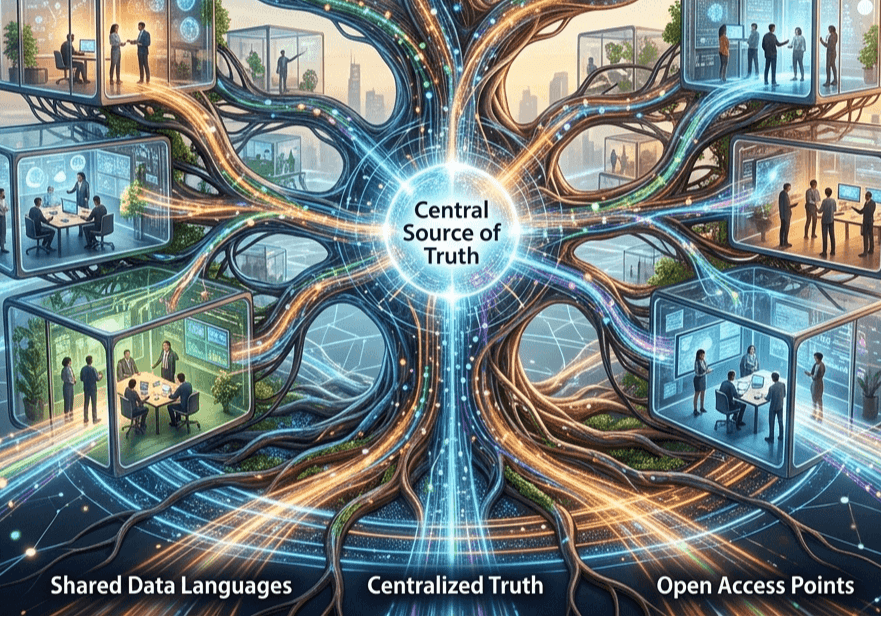
Are invisible walls slowing your team down? In many modern organizations, information remains trapped in separate "rooms" or silos, which are isolated departments that function apart from others and hinder cooperation .

Are you finding it hard to tell where your work life ends and your personal life begins?

In an era of "infinite tasks," many professionals have lost the time to actually be human . We spend our days "moving dirt"—performing manual reporting, calendar management, and repetitive data entry - instead of growing our careers .
Expertise List

Dedicated to empowering high-achieving individuals as they navigate the critical transition from initial "idea" phases to "market-ready" career pivots.
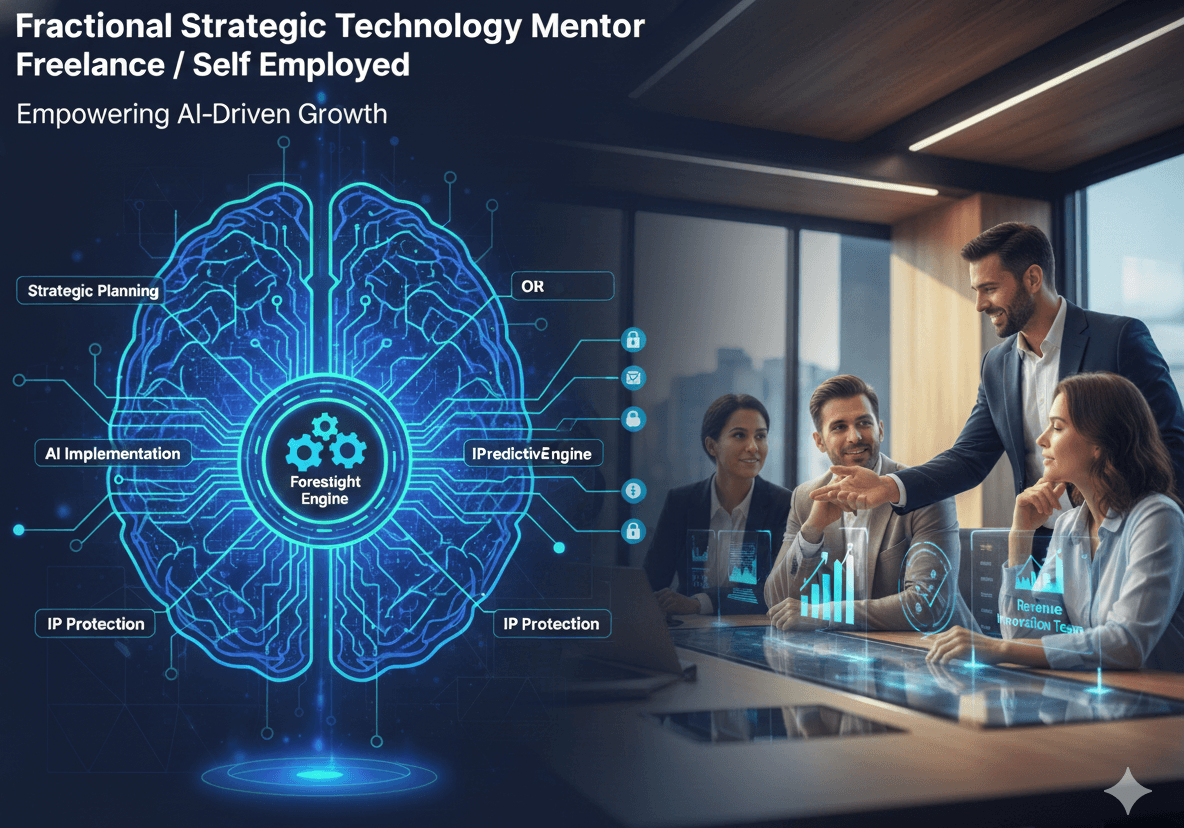
Acted in the capacity of an embedded strategic partner for Business Owners, I focus on translating core business objectives into high-performing, AI-driven systems.
This was a strategic leadership role focused on modernizing the company’s operations through technology, automation, and workforce development.
A high-impact leadership role centered on scaling a small business into a multi-state enterprise through aggressive digital transformation and process optimization.
Operations leader and digital transformation expert. Proven record modernizing infrastructure and cloud migrations, cutting data errors from 30% to <1%. Skilled in CRM architecture and vendor management, saving $300k annually through optimization.




JOIN MY MAILING LIST
RFE Online Rooted in purpose. Flourished by action. Expanded by potential.
Newsletter
The Weekly Evolve Insights to help you refine your path and exceed your goals.


© 2024 RFE Online. All rights reserved. | Privacy Policy | Terms and Conditions
Privacy policy | Legal | Terms and conditions