
Finding Your Inner Balance Through Mindfulness
Focus for February 2026
Harmonic Integration: Ensuring your daily habits and professional goals mirror your internal values to create a life that feels consistent and authentic.
Why Your Pursuit of Happiness is Making You Miserable (and 5 Better Ways to Find Balance)
Please like the video and subscribe to the channel for more videos.
1. The "Doing" Trap
In our increasingly fast-paced and hyper-connected world, most of us exist in a state of perpetual motion. We are caught in a cacophony of digital pings, frantic schedules, and the crushing weight of social expectations. This is the "doing" trap, a frenetic state where our mental intentions are completely severed from our physical reality, leaving us feeling fragmented and perpetually stuck.
To break this cycle, we need more than a simple vacation; we need a fundamental mental tune-up. The practice of mindfulness offers a pathway to Harmonic Integration. It is the process of shifting from the exhaustive "doing" mode into a consistent, grounded state of "being." By choosing alignment over activity, we allow our minds and bodies to finally inhabit the same moment.
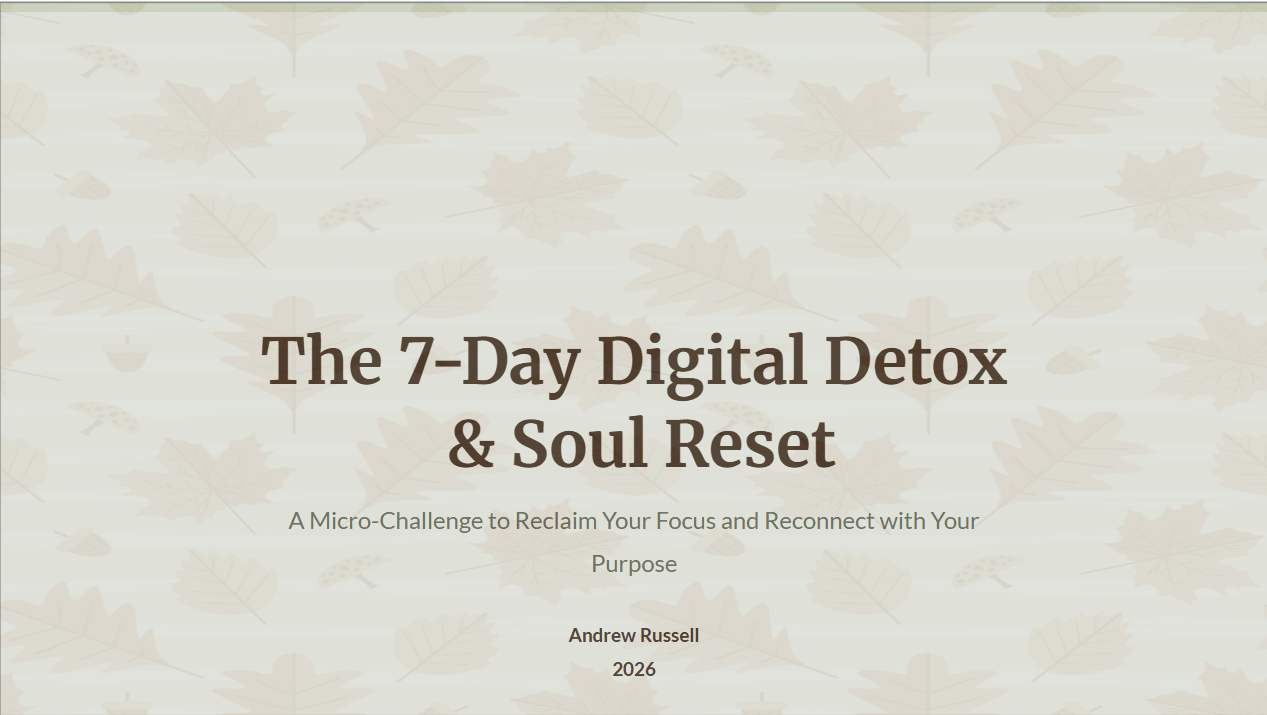
Try the Digital Detox to get the most out of your Journaling.
2. Stop Trying to Maximize Happiness
Traditional self-help often sells the dream of "maximizing" happiness, as if joy were a peak to be conquered and held. However, this pursuit is exactly what makes us miserable. It lands us on the hedonic treadmill, a relentless cycle where the chase for the next "high" ensures we are never truly satisfied.
The alternative is the Philosophy of Dynamic Balance. In this framework, mental health is not an all-or-nothing goal or a static state of perfection. Instead, it is a holistically patterned and contextually embedded phenomenon that breathes and changes over time. True harmony doesn't come from deleting negative emotions; it comes from integrating all parts of our experience. Our heavy responsibilities, our loftiest goals, and our fleeting sorrows, into a coherent, resilient whole.
3. You Are the Ocean, Not the Passing Waves
Achieving emotional stability requires a radical shift in perspective. Most of us mistake our passing thoughts for our identity. Mindfulness teaches us to observe our internal landscape as if we were watching a movie or listening to the wind, witnessing the weather without becoming the storm.
"recognizing that we are the 'vast ocean of awareness' witnessing these passing waves, not the waves themselves"
By identifying as the "ocean" (the core awareness) rather than the "waves" (the temporary emotions), you create a biological anchor. This perspective helps "sweep out the mental cobwebs," allowing you to remain steady and peaceful even when external circumstances are turbulent. You are the vast, deep expanse that remains unchanged by the surface chop.
4. The Secret Power of the "Buffer Zone"
At its core, mindfulness is the cultivation of Inner Focus, the act of being fully present without judgment. This focus does more than just calm the mind; it physically trains the brain to develop a buffer zone between a stimulus and your reaction.
This space is where your freedom lives. It allows you to choose a thoughtful, compassionate response rather than falling victim to an impulsive, ego-driven reaction. The benefits of maintaining this buffer zone are both mental and biological:
Stress Reduction: It provides a biological anchor that lowers cortisol levels, keeping the nervous system regulated under pressure.
Enhanced Focus: By training the mind to return to the "now," you can complete complex tasks without being derailed by the distractions of a fragmented world.
Emotional Stability: It promotes a sense of peace that remains stable through life's inevitable ups and downs.
Physical Well-being: This state of integration is linked to tangible markers like lower blood pressure and improved sleep quality.
5. Meditation Isn’t Just for Those Who Can Sit Still
For many, the idea of sitting in silence is a "hell of a drug", and not in a pleasant way. For a restless ego, the quiet can feel like "torture," a direct confrontation with a mind that refuses to slow down. If seated practice feels impossible, you can achieve the same Harmonic Integration through moving meditations.
These rhythmic, deliberate practices unite the mind and body just as effectively as sitting on a cushion:
Yoga
Tai Chi
Running
Mindful Walking
The key is the rhythm. When the body moves with intention, the mind follows, allowing you to find your center through action rather than stillness.
6. Escape the "Tyranny" of Single Thoughts with the Wheel of Awareness
If you feel overwhelmed by a specific pain or a recurring negative thought, Dr. Daniel Siegel’s Wheel of Awareness is a powerful tool for integration. Visualize a wheel where your awareness is the hub and everything you can perceive. Your five senses, your bodily sensations, your thoughts, and your relationships, sits on the rim.
The "spoke" of your attention can be moved intentionally from the hub to any point on the rim. By systematically moving this spoke, you link and integrate different elements of your being. This prevents you from being "lost" in any single segment. You are no longer trapped by the tyranny of one painful thought; instead, you are the hub, capable of acknowledging the thought without being consumed by it. Integration, in this sense, is the very definition of health.

7. Conclusion: Taking It Off the Cushion
The ultimate goal of seeking balance is not to become a "good meditator," but to take these insights "off the cushion" and into the messy reality of daily life. This is the path of Random Mindfulness Moments. Setting a timer or a mental trigger to check in with your surroundings and breathe.
You can transform the most mundane chores into sacred acts of presence. Whether you are washing dishes, showering, or driving through traffic, you can choose to be fully present to what you are doing, one movement and one moment at a time. This consistent attunement builds the emotional and social intelligence necessary for a life that feels truly "in tune" with itself.
By choosing to participate in your own health through these intentional habits, you create a foundation for inner peace and freedom. You stop chasing a fleeting high and start discovering the potential that exists when you are finally, fully present.
How will you choose to participate in your own health today?

In the spirit of navigating new horizons, much like aligning your health with your thoughts and attitude, the research for this video and blog was collated using Google Notebook - an example of using AI as a strategic thought partner to help map out the journey of the soul.
#mindfulness, #harmonicintegration, #stressrelief, #mentalhealth, #meditationforbeginners, #innerpeace, #emotionalwellbeing, #mindfulwalking, #wellness, #selfcare
Sources of Information
Below is the source information list for the documents used to create the blog post, as found in the provided sources.
Beyond polarization towards dynamic balance: harmony as the core of mental health
URL/Identifier: PMCID: PMC10525342 / doi: 10.3389/fpsyg.2023.1177657
Description: An academic article published in Frontiers in Psychology that proposes a new definition of mental health focused on harmonious balance and dynamic integration rather than the simple maximization of positive emotions.
Harmonic Integration
URL/Identifier: Harmonic Integration (Website excerpts)
Description: A description of the holistic healing framework developed by Tanya Witman (LAC, LMT, MA), which integrates yoga, bodywork, movement, and counseling to align the body, mind, and spirit.
MEDITATION FOR BEGINNERS: A Comprehensive Guide
URL/Identifier: Zenful Spirit
Description: A practical guidebook providing step-by-step instructions for seated meditation, exploring moving meditations (such as Yoga and Tai Chi), and teaching the cultivation of mindfulness and compassion.
Mindfulness as Integration
URL/Identifier: Psychology Today Australia
Description: An article by Daniel J. Siegel, M.D., that introduces the Wheel of Awareness and discusses how mindfulness acts as an integrative practice for brain health and interpersonal relationships.
Mindfulness vs Flow: Opposing Self-Improvement Concepts? - SCIENCE REVIEW
URL/Identifier: Reddit (r/Mindfulness)
Description: A science review post that summarizes research (including 13 distinct studies) on the positive correlation between mindfulness and the ability to enter "flow states".
Mindfulness-based music therapy for mental health in senior college students: a randomized controlled trial
URL/Identifier: Frontiers (doi: 10.3389/fpsyg.2025.1649395)
Description: A scientific study reporting on a randomized controlled trial that utilized Mindfulness-Based Music Therapy (MBMT) to improve resilience and reduce anxiety and depression in senior students.
Wave Turbulence and Cortical Dynamics
URL/Identifier: arXiv
Description: A theoretical paper exploring large-scale brain activity (cortical dynamics) and its relationship to wave turbulence, harmonic generation, and spectral dispersion.
What are the benefits of mindfulness?
URL/Identifier: American Psychological Association
Description: Though included in the provided sources, the content for this specific document was marked as an unsuccessful request and did not contribute direct information to the response.



RFE Online Rooted in purpose. Flourished by action. Expanded by potential.
Newsletter
The Weekly Evolve Insights to help you refine your path and exceed your goals.
© 2024 RFE Online. All rights reserved. | Privacy Policy | Terms and Conditions
Privacy policy | Legal | Terms and conditions